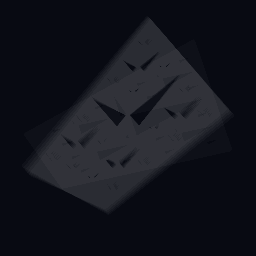
fractals_3d_webgl · SierpinskiTetrahedron3D
Sierpinski tetrahedron (tetrix) 3D chaos game
A 3D chaos-game rendering of the Sierpinski tetrahedron (tetrix): a regular tetrahedron recursively replaced by four half-size copies at its corners (Hausdorff dimension log(4)/log(2) = 2). Many random 3D walkers are integrated against the IFS {v_i -> (v_i + p_i) / 2} for the four vertices p_i of a regular tetrahedron; after a short burn-in the orbit becomes dense in the tetrix. The full 3D point cloud is then orthographically projected to 2D from a slow camera orbit and splatted into a decaying frame buffer with a depth-driven warm/cool palette.
Original: https://en.wikipedia.org/wiki/Sierpinski_tetrahedron
▶ Try the live demo (JS port) ▶ Run reference.py via Pyodide 10 formulas have instant JS ports. The Pyodide path runs the actual Python in your browser — first load is ~6 MB, then instant.
Math essence
For a tetrahedron with vertices p_0..p_3, iterate x_{n+1} = (x_n + p_{c(n)}) / 2 where c(n) is uniform in {0,1,2,3}. After a burn-in, the orbit is a 3D point cloud on the tetrix. Project with a 3D rotation by pitch/yaw, splat each point into a small radius on the canvas with additive weight, and let a per-step decay blend frames so the orbit camera animation accumulates an organic soft glow.
Parameters
| Name | Type | Default | Range | Description |
|---|---|---|---|---|
dim | int | 256 | 128–512 | Square canvas side length in pixels. |
num_walkers | int | 4000 | 500–20000 | Number of independent 3D chaos-game walkers. |
n_steps | int | 400 | 50–4000 | Steps per walker (after a short burn-in). |
camera_pitch | float | 0.55 | -1.2–1.2 | Camera pitch (radians). |
camera_yaw | float | 0.4 | -1.2–1.2 | Camera yaw (radians). |
orbit_speed | float | 0.1 | 0–0.4 | Per-step camera phase increment. |
splat_radius | float | 0.55 | 0–3 | Soft splat radius (px) for each chaos-game point. |
decay | float | 0.97 | 0.7–0.999 | Per-step canvas fade. |
palette_warm | tuple | 255,200,130 | — | Foreground end of the depth palette (close to camera). |
palette_cool | tuple | 90,200,255 | — | Background end of the depth palette (far from camera). |
background | tuple | 8,10,18 | — | Background colour. |
seed | int | 7 | 0–999 | RNG seed. |
Reference
First 60 lines of reference.py. Full source:
library_external/fractals_3d_webgl/SierpinskiTetrahedron3D/reference.py
from __future__ import annotations

from typing import ClassVar

import numpy as np


def _tetra_chaos_iterate(
    n_pts: int, n_steps: int, seed: int | None
) -> tuple[np.ndarray, np.ndarray]:
    """Chaos-game iteration in 3D for the Sierpinski tetrahedron.

    Four regular-tetrahedron vertices A, B, C, D.  At each step pick
    one vertex uniformly at random and replace the current point by
    (current + vertex) / 2.  After a small burn-in the trajectory
    becomes dense in the tetrix.  Returns (xs, ys, zs) of shape
    (n_steps, n_pts).
    """
    rng = np.random.default_rng(seed)
    # Regular tetrahedron with centroid at origin
    s = 1.0
    verts = np.array(
        [
            [s, s, s],
            [s, -s, -s],
            [-s, s, -s],
            [-s, -s, s],
        ],
        dtype=np.float32,
    )
    x = rng.uniform(-0.1, 0.1, size=n_pts).astype(np.float32)
    y = rng.uniform(-0.1, 0.1, size=n_pts).astype(np.float32)
    z = rng.uniform(-0.1, 0.1, size=n_pts).astype(np.float32)
    xs = np.empty((n_steps, n_pts), dtype=np.float32)
    ys = np.empty((n_steps, n_pts), dtype=np.float32)
    zs = np.empty((n_steps, n_pts), dtype=np.float32)
    burn = max(8, n_steps // 50)
    for i in range(n_steps):
        which = rng.integers(0, 4, size=n_pts)
        v = verts[which]
        x = (x + v[:, 0]) * 0.5
        y = (y + v[:, 1]) * 0.5
        z = (z + v[:, 2]) * 0.5
        if i >= burn:
            xs[i - burn] = x
            ys[i - burn] = y
            zs[i - burn] = z
    return xs, ys, zs


class SierpinskiTetrahedron3D:
    """Sierpinski tetrahedron (tetrix) — Waclaw Sierpinski (1915).

    The 3D analogue of the Sierpinski triangle: start with a regular
    tetrahedron, replace it with four half-size copies at its corners,
    and recurse.  In the limit the volume goes to zero while the
    surface area stays constant; the Hausdorff dimension is
    log(4)/log(2) = 2.

    This implementation uses the *chaos game*: spawn many random
Try running it locally
The reference implementation is self-contained Python with numpy. Install the package and run:
python library_external/fractals_3d_webgl/SierpinskiTetrahedron3D/reference.pyNeed help? See Learn for the standard environment setup, or Playground for an in-browser sketchbook.
More from fractals_3d_webgl
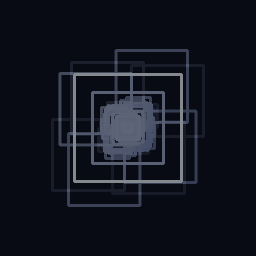
3D Menger sponge level-3 wireframe
fractals_3d_webgl · MengerSponge3DLevel3
A level-3 3D Menger sponge explicitly generated as 20^3 = 8000 kept sub-cubes and rasterised as a 12-edge wireframe projection.
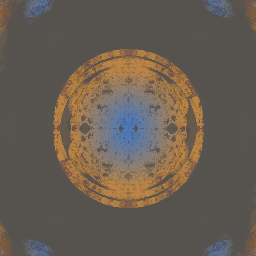
Mandelbox fold-scale 2D projection
fractals_3d_webgl · MandelboxFoldScale
A 2D orthographic projection of Tom Lowe's Mandelbox (2010) escape-time field.
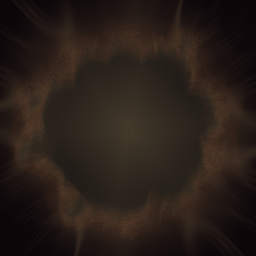
Mandelbulb power-8 2D projection
fractals_3d_webgl · Mandelbulb2DProjection
A 2D orthographic projection of the iconic power-8 Mandelbulb escape-time field.
Poincare-disk hyperbolic tiling (Escher / Coxeter)
fractals_3d_webgl · HyperbolicTilingPoincare3D
A 3D hyperboloid-lifted rendering of the (p, q) hyperbolic tessellation in the Poincare disk model.