hodgin_iquilezles · WorleyNoise
Worley / Cellular Noise
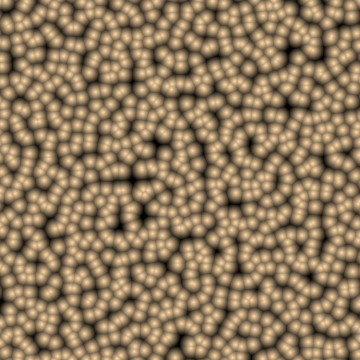
Quilez's classic 2D Worley noise: a unit grid of cells, each containing one pseudo-random feature point placed by a 2D integer hash. At every pixel, the value is the distance to the closest feature point in the 3x3 neighbourhood (F1), the F2-F1 cell-edge distance, or a colour from the integer cell id. Multi-octave summation produces tileable organic cellular textures.
Original: https://iquilezles.org/articles/smoothvoronoi/
▶ Try the live demo (JS port) ▶ Run reference.py via Pyodide 10 formulas have instant JS ports. The Pyodide path runs the actual Python in your browser — first load is ~6 MB, then instant.
Math essence
For a query point x with cell index p = floor(x) and fractional part f, scan the 3x3 neighbour cells (p+offset). Each cell hosts one feature point at hash(cell). Compute squared distances to these 9 points; keep F1 = min and F2 = second-min. Render via sqrt(F1) or sqrt(F2-F1) or by hashing F1's owner cell id. Multi-octave stacking scales frequency by 2 and amplitude by 0.55 per octave.
Parameters
| Name | Type | Default | Range | Description |
|---|---|---|---|---|
dim | int | 360 | 120–800 | Square output size in pixels. |
scale | float | 12 | 2–80 | Number of Worley cells across the canvas. |
octaves | int | 1 | 1–5 | Number of stacked octaves. |
contrast | float | 1 | 0.25–4 | Post-field contrast multiplier. |
mode | string | f1 | null–null | Output mode: f1, f2_minus_f1, or id (Voronoi cell id colour). |
hue_shift | float | 0 | 0–1 | Hue rotation applied when mode='id'. |
Reference
First 60 lines of reference.py. Full source:
library_external/hodgin_iquilezles/WorleyNoise/reference.py
from __future__ import annotations

from typing import ClassVar

import numpy as np


def _hash2(ix: np.ndarray, iy: np.ndarray, seed: int) -> tuple[np.ndarray, np.ndarray]:
    ix = ix.astype(np.uint64, copy=False)
    iy = iy.astype(np.uint64, copy=False)
    s = np.uint64(np.int64(seed) & 0xFFFFFFFF) * np.uint64(0x9E3779B97F4A7C15)
    s &= np.uint64(0xFFFFFFFFFFFFFFFF)
    h = (ix * np.uint64(0x27D4EB2F165667C5)) ^ (
        iy * np.uint64(0x165667B19E3779F9)
    ) ^ s
    h &= np.uint64(0xFFFFFFFFFFFFFFFF)
    h ^= h >> np.uint64(33)
    h *= np.uint64(0xFF51AFD7ED558CCD)
    h &= np.uint64(0xFFFFFFFFFFFFFFFF)
    h ^= h >> np.uint64(33)
    h *= np.uint64(0xC4CEB9FE1A85EC53)
    h &= np.uint64(0xFFFFFFFFFFFFFFFF)
    h ^= h >> np.uint64(33)
    a = (h & np.uint64(0xFFFFFFFF)).astype(np.float64) / 4294967296.0
    h ^= h >> np.uint64(27)
    b = (h & np.uint64(0xFFFFFFFF)).astype(np.float64) / 4294967296.0
    return a.astype(np.float32), b.astype(np.float32)


class WorleyNoise:
    """Worley / Cellular Noise — Inigo Quilez (iquilezles.org).

    Quilez's classic 2D Worley noise (a.k.a. cellular noise, Voronoi noise)
    partitions the plane into a regular grid of unit cells, places a single
    pseudo-random feature point inside each cell using his compact 2D hash,
    and at every query point ``x`` returns the distance to the closest
    feature point in the 3×3 cell neighborhood.

    The image is rendered by sampling the scalar field at every pixel and
    colouring by the F1 distance, the F2-F1 difference (cell edges), or a
    hash of the nearest cell id (Voronoi diagram).

    Reference code is from the canonical Quilez snippet:

        float voronoi( in vec2 x ) {
            ivec2 p = ivec2( floor( x ) );
            vec2  f = fract( x );
            float res = 8.0;
            for ( int j=-1; j<=1; j++ )
            for ( int i=-1; i<=1; i++ ) {
                ivec2 b = ivec2( i, j );
                vec2  r = vec2( b ) - f + hash2( p + b );
                float d = dot( r, r );
                res = min( res, d );
            }
            return sqrt( res );
        }

    (See also https://iquilezles.org/articles/voronoise/ for IQ's "voro-noise"
    extension.)
Try running it locally
The reference implementation is self-contained Python with numpy. Install the package and run:
python library_external/hodgin_iquilezles/WorleyNoise/reference.pyNeed help? See Learn for the standard environment setup, or Playground for an in-browser sketchbook.
More from hodgin × iquilezles
Boids Flock (Hodgin Murmuration)
hodgin_iquilezles · BoidsFlock
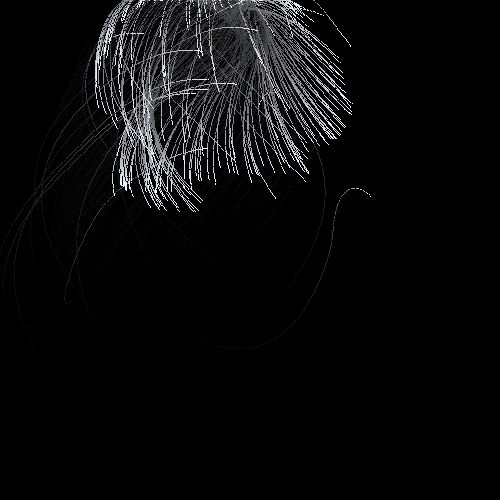
A 2D flock of boids steered by Craig Reynolds' three classic rules (separation, alignment, cohesion) over a coarse spatial-hash neighbor query.
Fractional Brownian Motion noise
hodgin_iquilezles · FBMNoise
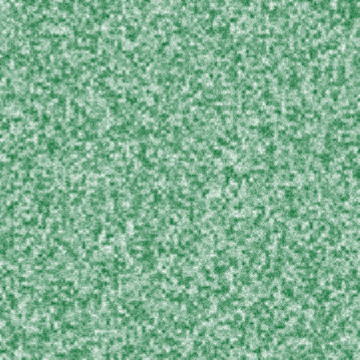
Quilez's canonical fBM: a 2D value-noise base summed over N octaves whose frequency doubles and amplitude is multiplied by G = exp2(-H) per octave.
Magneto Particles (Hodgin Magnetosphere)
hodgin_iquilezles · MagnetoParticles
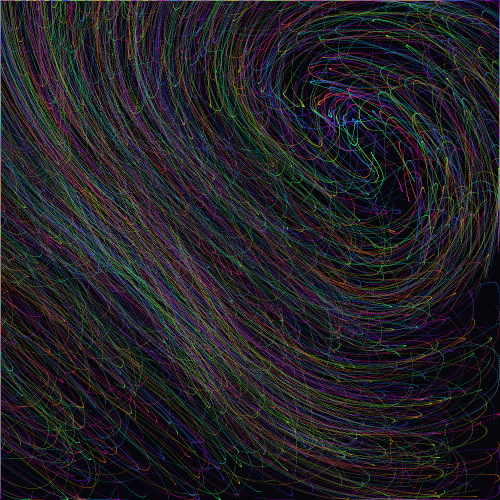
Particles pulled and pushed by N orbiting magnetic anchors whose charges flip sign over time.
Mulberry32 PRNG (stratified scatter)
hodgin_iquilezles · Mulberry32RNG
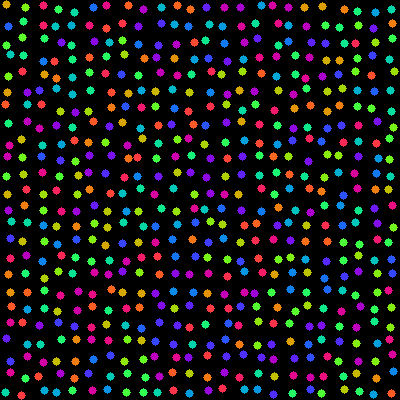
Mulberry32 is a tiny 32-bit-state pseudo-random number generator popularised in the demoscene and used pervasively by Quilez and other graphics programmers as the RNG inside procedural sketches.
Saturn Rings (orbital resonance)
hodgin_iquilezles · SaturnRings
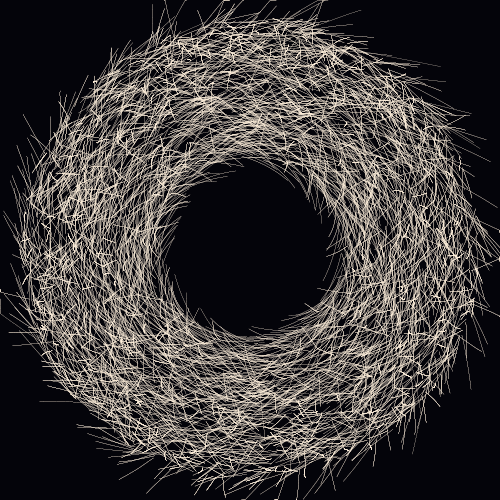
Thousands of particles are initialized in an annulus between inner_radius and outer_radius around a central mass, with circular orbital velocities v = sqrt(M/r).
Smooth-Minimum SDF field
hodgin_iquilezles · SmoothMinSDF
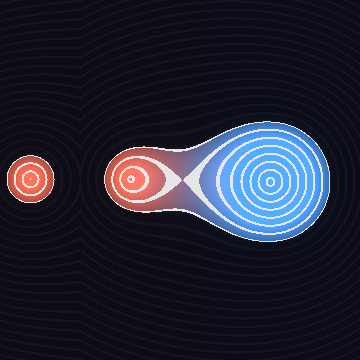
Two animated 2D SDF primitives (a moving circle and a translating slab) are blended with Quilez's quadratic-polynomial smooth-minimum and rendered as a scalar field.