
toxi_openframeworks · GenerativeTypeLetterforms
Generative Type Letterforms
Letterforms assembled from a 9×9 stroke grid alphabet (A–Z subset), then modulated by a parametric function (bar widths and stroke positions follow `a * sin(b*x + c)` style curves) and optionally recursively subdivided into smaller marks. The skeleton is the parametric-typography idea behind Karsten Schmidt's `thi.ng/font` (which defines glyphs from grids of vertical / horizontal / diagonal / dot primitives via a JSON grammar) and the oF / Processing generative-typography canon (Rune Madsen's *Printing Code*) where letters are shape systems rather than polygon outlines.
Original: https://github.com/thi-ng/font
▶ Try the live demo (JS port) ▶ Run reference.py via Pyodide 10 formulas have instant JS ports. The Pyodide path runs the actual Python in your browser — first load is ~6 MB, then instant.
Math essence
Each character lives on a fixed 9×9 grid. For each 'on' cell at (i, j), compute mod = amp * sin(freq*π*i/(n-1) + phase) + amp/2 * sin(...). In `modulate` mode the cell size is locally scaled by `(1 + 0.35*mod)`. In `shift` mode the cell is translated by `(cell * mod, cell * mod)`. With probability `subdiv_prob`, a randomly-colored sub-cell (the 'glow' color) is painted at the cell location. The output is rasterized to a HxWx3 image with the chosen ink/glow/bg colors.
Parameters
| Name | Type | Default | Range | Description |
|---|---|---|---|---|
dim | int | 360 | 200–1000 | Square canvas side length in pixels. |
text | str | TOXI | — | Text to render (uppercased, A-Z glyph subset). |
cell_size | int | 28 | 8–64 | Base pixel size of one stroke cell. |
param_freq | float | 1.6 | 0.5–8 | Spatial frequency of the modulating sinusoid. |
param_amp | float | 0.55 | 0–1 | Amplitude of the modulating sinusoid. |
subdiv_prob | float | 0.35 | 0–1 | Per-cell probability of a sub-mark being added. |
subdiv_levels | int | 1 | 0–4 | Recursion depth for sub-marks. |
mode | str | modulate | — | How the parametric function affects each cell. |
bg_color | tuple | 245,240,230 | — | Background colour. |
ink_color | tuple | 38,38,52 | — | Main glyph stroke colour. |
glow_color | tuple | 220,90,70 | — | Sub-mark / subdivision colour. |
seed | int | null | 0–999999 | RNG seed. |
Reference
First 60 lines of reference.py. Full source:
library_external/toxi_openframeworks/GenerativeTypeLetterforms/reference.py
from __future__ import annotations

from typing import ClassVar

import numpy as np


_GLYPHS: dict[str, str] = {
    "A": (
        "#########"
        "##.....##"
        "##.....##"
        "##.....##"
        "#########"
        "##.....##"
        "##.....##"
        "##.....##"
        "##.....##"
    ),
    "B": (
        "########."
        "##....##."
        "##....##."
        "##....##."
        "########."
        "##....##."
        "##....##."
        "##....##."
        "########."
    ),
    "C": (
        ".########"
        "##......."
        "##......."
        "##......."
        "##......."
        "##......."
        "##......."
        "##......."
        ".########"
    ),
    "D": (
        "########."
        "##....##."
        "##.....##"
        "##.....##"
        "##.....##"
        "##.....##"
        "##.....##"
        "##....##."
        "########."
    ),
    "E": (
        "#########"
        "##......."
        "##......."
        "##......."
        "########."
        "##......."
        "##......."
Try running it locally
The reference implementation is self-contained Python with numpy. Install the package and run:
python library_external/toxi_openframeworks/GenerativeTypeLetterforms/reference.pyNeed help? See Learn for the standard environment setup, or Playground for an in-browser sketchbook.
More from toxi · openFrameworks
Gray-Scott Reaction-Diffusion
toxi_openframeworks · ReactionDiffusionGS
The canonical two-species Gray-Scott reaction-diffusion model on a periodic square grid: dU/dt = Du*lap(U) - U*V^2 + F*(1-U), dV/dt = Dv*lap(V) + U*V^2 - (F+k)*V.
Median-Cut Color Quantizer
toxi_openframeworks · ColorQuantizer
Heckbert's 1982 median-cut color quantization applied to an evolving procedural gradient + low-resolution noise wash.
Pixel Sort (Glitch Art)
toxi_openframeworks · PixelSort
Per-row pixel sorting à la Kim Asendorf's `ASDFPixelSort` and Karsten Schmidt's own glitch-art Processing sketches.
Sound-Reactive Particle Field (Synthetic Audio)
toxi_openframeworks · SoundReactiveField
Particles advected by a force field whose horizontal component is driven by a synthetic audio signal: a chain of N sinusoids at different frequencies/amplitudes (the 'audio'), with the audio's instantaneous value plus its time derivative ('beat onset') driving the field.
Verlet Particle-Spring Network
toxi_openframeworks · ParticleSpring2D
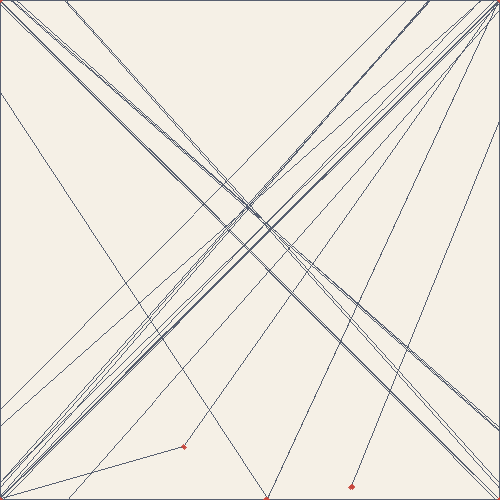
A Verlet-integrated particle network connected to its k-nearest neighbours by Hooke's-law springs.
Voronoi Tessellation with Lloyd Relaxation
toxi_openframeworks · VoronoiRelaxation
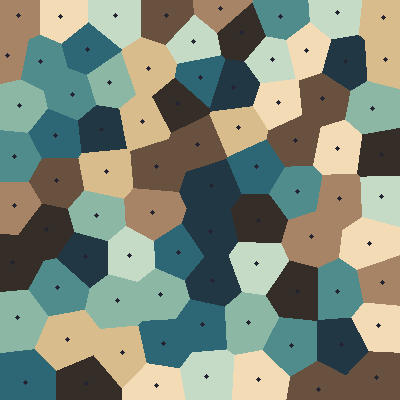
Lloyd's algorithm applied to a jittered point cloud: each seed is replaced with the centroid of its Voronoi cell, repeatedly, producing ever-more-uniform polygonal cells.