art_blocks · DcaGenesis
Genesis (DCA — Day-Zero Art Blocks)
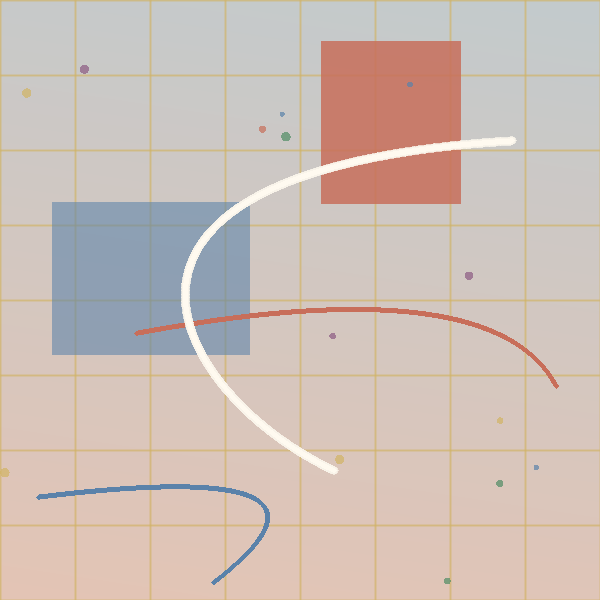
An interpretation of DCA's *Genesis* (Art Blocks #1, November 2020) — one of three Day-Zero collections (alongside Snowfro's Chromie Squiggle and Jeff Davis's Construction Token) that minted in the first 24 hours of the Art Blocks platform. Genesis is a 512-piece 'Generative System' of grids, gradients, lines, shapes and colours that 'harmonize with each other' — compositions built from a grid substrate (the Grid trait), background rectangles (RECT1, RECT2, Colored Trapezoid), Bezier curves (Curve, the canonical 99-variant trait including the 13-piece Glowing Bezier grail), and dot sprinkles (Dots = 47 variants, White Sprinkles = 25, Soft Points = 22). DCA described the early script as having 'large dots at the vertex of each triangle, a feature that was later removed.' Cherniak has cited Genesis alongside Squiggle as the work that inspired Ringers. This implementation layers the canonical features (gradient → grid → rectangles → bezier → dots → glowing bezier) one step at a time so the Genesis composition builds up sequentially.
Original: https://verse.works/series/genesis-by-dca
▶ Try the live demo (JS port) ▶ Run reference.py via Pyodide 10 formulas have instant JS ports. The Pyodide path runs the actual Python in your browser — first load is ~6 MB, then instant.
Math essence
1. Linear gradient between two palette colours in a random direction. 2. (grid_n+1) x 2 grid lines at low alpha. 3. rect_count filled rectangles with random position, size and alpha. 4. curve_count quadratic Bezier curves with random control points. 5. dot_count small filled circles at random positions. 6. (optional) cubic-Bezier 'glowing' signature line in white, drawn twice — once opaque + once with a low-alpha thick pass for the glow.
Parameters
| Name | Type | Default | Range | Description |
|---|---|---|---|---|
dim | int | 600 | 200–1500 | Square canvas side length (px). |
grid_n | int | 8 | 2–24 | Grid side N (N x N cells). |
rect_count | int | 2 | 0–6 | Background rectangles (Genesis: RECT1, RECT2, Colored Trapezoid). |
curve_count | int | 2 | 0–8 | Bezier curves through the grid. |
dot_count | int | 14 | 0–200 | Dot sprinkles (Genesis Dots / Soft Points / White Sprinkles). |
glowing_bezier | bool | false | null–null | If True, overlay the Glowing Bezier signature (rare grail trait, 13 of 99 Curve variants). |
palette | list | 200,110,90,90,130,170,210,180,100,140,90,130,80,140,100 | null–null | Per-piece palette (Genesis DNA: 2–5 colours). |
background | tuple | 240,234,220 | null–null | Background RGB colour. |
seed | int | 7 | 0–2147483647 | RNG seed. |
Reference
First 60 lines of reference.py. Full source:
library_external/art_blocks/DcaGenesis/reference.py
"""DcaGenesis — DCA's Genesis (Art Blocks #1, 2020).

Genesis was one of the three Art Blocks "Day Zero" collections
(alongside Chromie Squiggle and Construction Token), minted on
November 27–28, 2020 — the very first Art Blocks mints ever.
DCA (Daniel Calderon Arenas, brother of Snowfro / Erick Calderon)
authored Genesis as a 512-piece generative work described by DCA as
a "Generative System" — compositions of grids, gradients, lines,
shapes and colours, harmonised together.

DCA on Genesis (Bright Moments interview):

    "Erick had the idea to use 'Genesis' as the test project while
    he was making Art Blocks. And I liked that a lot."

    "One main visual factor is the large dots at the vertex of each
    triangle, a feature that was later removed."  (early-script output)

Per The Line's 2025 documentation of Genesis:
- 512 mints (limited edition), sold out at launch.
- Curve, Dots, Special are the more interesting rarity traits.
- Glowing Bezier (13 of 99 in the Curve trait) is the canonical
  "grail" trait variant — a white signature-line Bezier through
  the composition.
- White Sprinkles (25), Soft Points (22) of Dots (47) are the
  "salt bae" Genesis variants.

The algorithm — paraphrased from DCA's interviews and the documented
Genesis traits:

    1. Lay out a grid of cells (the Grid trait) with diagonal coverage
       across the canvas.
    2. Place rectangles (RECT1, RECT2) and trapezoids (Colored
       Trapezoid) — the geometric substrate.
    3. Draw curved Bezier paths through the grid (the Curve trait).
    4. Add dots at strategic vertices (the Dots trait, originally
       drawn at every triangle vertex).
    5. Optionally add a Glowing Bezier signature line (the rare
       Glowing Bezier trait).
    6. Background gradient + a soft scatter of "sprinkles" (the
       White Sprinkles / Soft Points traits).

Reference:
- https://verse.works/series/genesis-by-dca
- https://www.theline.wtf/storyline/the-genesis-of-generative-with-dca
- https://www.ensemble.art/story/unseen-visions
- Bright Moments, *BOSQUE DE CHAPULTEPEC BY DCA*: https://www.brightmoments.io/quarterly/dca

NB: This implementation is inspired by the Genesis aesthetic — grid
+ gradient + Bezier curves + dot sprinkles + signature line — but
the canonical Genesis JS script is not public, so the algorithm here
is an interpretation, not a 1:1 reproduction.
"""
from __future__ import annotations

from typing import ClassVar

import numpy as np
Try running it locally
The reference implementation is self-contained Python with numpy. Install the package and run:
python library_external/art_blocks/DcaGenesis/reference.pyNeed help? See Learn for the standard environment setup, or Playground for an in-browser sketchbook.
More from art blocks
Cherniak Ringers (Dmitri Cherniak — Ringers)
art_blocks · CherniakRingers
An implementation of Dmitri Cherniak's *Ringers* algorithm (Art Blocks Curated, January 2021, 1,000 NFTs) — one of the most-cited generative-art projects of the NFT era, and the source of *Ringers #879* ('The Goose') and *Ringers #962* (acquired by LACMA).
Chromie Squiggle (Snowfro / Cherniak — Squiggles)
art_blocks · CherniakSquiggles
An implementation of the squiggle-generation kernel used in Snowfro's *Chromie Squiggle* (Art Blocks #0, November 2020) — the on-chain generative-art project that launched the Art Blocks platform itself and was the work Dmitri Cherniak cited (alongside *Genesis*) as his inspiration for Ringers.
Hobbs Flow Field (Tyler Hobbs — Incomplete Control / Fidenza)
art_blocks · HobbsFlowField
The canonical perlin-noise flow-field algorithm described by Tyler Hobbs in his 2020 essay 'Flow Fields', and the algorithmic backbone of his Art Blocks Curated works *Incomplete Control* (Bright Moments, 2021) and *Fidenza* (Art Blocks, 2021).
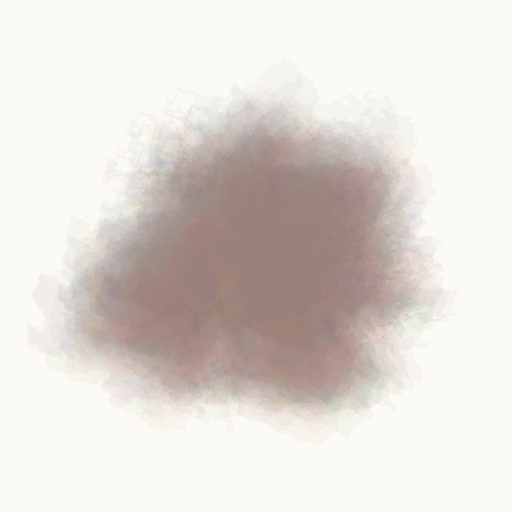
Hobbs Watercolor Blob
art_blocks · HobbsWatercolorBlob
Layered translucent Gaussian blobs with watercolor-style alpha falloff.
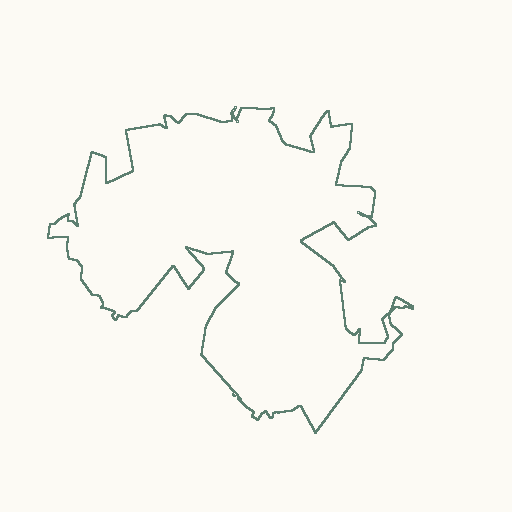
Hobbs Watercolor Edge (Tyler Hobbs — Soft Textures / Watercolor)
art_blocks · HobbsWatercolorEdge
An implementation of Tyler Hobbs' 2017 'watercolor' technique: a recursive polygon-deformation algorithm whose midpoints are jittered by Gaussian noise across many passes, then stacked with low alpha (4% per layer, 30–100 layers total) to produce the soft, ink-bleed look of wet pigment on paper.
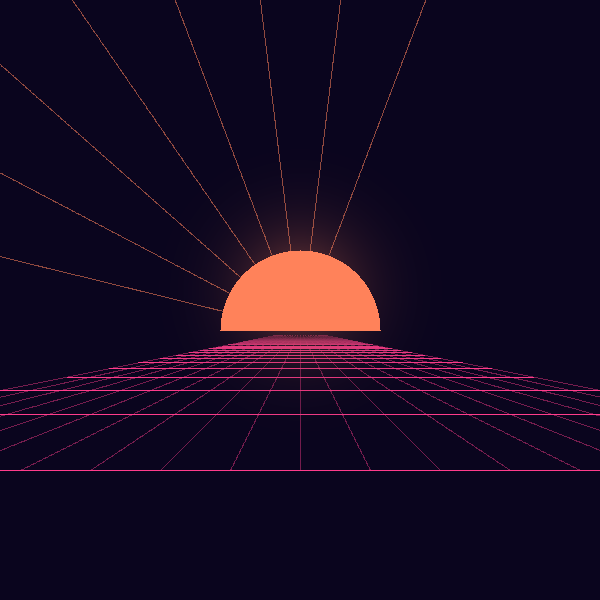
Penne 80s Vector (Aaron Penne — outrun perspective wireframe)
art_blocks · Penne80sVector
The 80s-synthwave outrun grid, the visual aesthetic Aaron Penne references in his generative-art practice (notably in *Apparitions* and his broader body of work).