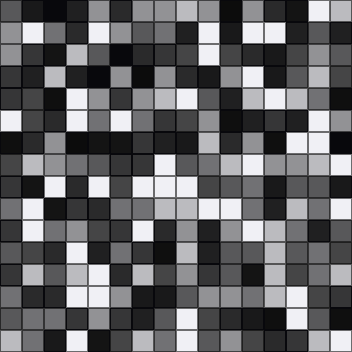
audio_reactive · SNDGridSequencer
SND Grid Sequencer (Multistability Pulse Grid)
A 16×16 grid where each cell has its own activation period (inner-loop ticks) and phase offset, modelled after Mark Fell's *Multistability* algorithm: nested inner/outer loops, impulse at each inner-loop wrap, phase-reset by the outer loop. Cells fire when (tick + phase) mod inner_period == 0 (and not during an outer wrap), producing a synchronised pulse pattern reminiscent of the SND multislider sequencer. Beat rows are weighted higher (the SND kick / snare / hat channels). Visualisation: white-on-black minimal grid with a faint glow on each fire — the *sensate focus* pencil-tool aesthetic that Fell contrasted with his algorithmic solo work.
Original: https://sonicacts.com/archive/mark-fell
▶ Try the live demo (JS port) ▶ Run reference.py via Pyodide 10 formulas have instant JS ports. The Pyodide path runs the actual Python in your browser — first load is ~6 MB, then instant.
Math essence
inner_period, outer_period, phase, outer_phase ∈ [inner_min..inner_max]^G×G. fire_mask = ((tick + phase) mod inner_period == 0) ∧ ¬((tick + outer_phase) mod outer_period == 0). energy[fire] = beat_boost[beat_rows]; energy[¬fire] *= 0.78. canvas[y0:y1, x0:x1] = fg_color * energy for each cell; 1-cell glow halo when energy > 0.25.
Parameters
| Name | Type | Default | Range | Description |
|---|---|---|---|---|
grid_size | int | 16 | 8–32 | Side length of the square cell grid. |
inner_min | int | 3 | 1–8 | Minimum inner-loop period (in ticks). |
inner_max | int | 13 | 4–32 | Maximum inner-loop period (in ticks). |
outer_min | int | 5 | 2–16 | Minimum outer-loop period (in ticks). |
outer_max | int | 31 | 8–64 | Maximum outer-loop period (in ticks). |
beat_rows | tuple | 0,4,8,12 | — | Row indices that get the beat boost (e.g. SND kick/snare/hat channels). |
beat_boost | float | 1.6 | 0.5–4 | Multiplier for beat-row cells. |
cell_size | int | 22 | 10–48 | Pixel size of each cell. |
glow_radius | int | 1 | 0–4 | Pixel halo around each fired cell. |
bg_color | tuple | 8,8,12 | — | Background colour. |
fg_color | tuple | 240,240,245 | — | Foreground colour. |
seed | int | null | 0–999999 | RNG seed. |
Reference
First 60 lines of reference.py. Full source:
library_external/audio_reactive/SNDGridSequencer/reference.py
from __future__ import annotations

from typing import ClassVar

import numpy as np


class SNDGridSequencer:
    """Mark Fell / SND grid-sequencer aesthetic.

    A 16×16 grid where each cell has its own activation period
    (in ticks) and phase offset. Every step, a cell fires if
    ``(tick + phase) mod period == 0``, producing a synchronised
    pulse pattern reminiscent of the SND multislider sequencer
    (Fell's *Multistability* algorithm: nested inner/outer loops,
    impulse at each inner-loop wrap, phase-reset by the outer loop).
    Fired cells light up at their current "velocity" (the value
    computed by Mark Fell's two-loop accumulator: count from 0..1
    over inner-loop-length, snap-impulse on wrap). A handful of
    rows are weighted as "downbeats" with extra brightness, the
    way Fell pencils in kick / snare / hat channels.

    Visualisation is a white-on-black minimal grid with a faint
    outer glow on every fire — the *sensate focus* pencil-tool
    aesthetic that Fell contrasted with his algorithmic solo work.
    """

    family: ClassVar[str] = "audio_reactive"
    sketch: ClassVar[str] = "sndgridsequencer"

    def __init__(
        self,
        grid_size: int = 16,
        inner_min: int = 3,
        inner_max: int = 13,
        outer_min: int = 5,
        outer_max: int = 31,
        beat_rows: tuple[int, ...] = (0, 4, 8, 12),
        beat_boost: float = 1.6,
        cell_size: int = 22,
        glow_radius: int = 1,
        bg_color: tuple[int, int, int] = (8, 8, 12),
        fg_color: tuple[int, int, int] = (240, 240, 245),
        seed: int | None = None,
    ) -> None:
        self.grid_size = grid_size
        self.inner_min = inner_min
        self.inner_max = inner_max
        self.outer_min = outer_min
        self.outer_max = outer_max
        self.beat_rows = np.array(beat_rows, dtype=np.int32)
        self.beat_boost = beat_boost
        self.cell_size = cell_size
        self.glow_radius = glow_radius
        self.bg_color = np.array(bg_color, dtype=np.float32)
        self.fg_color = np.array(fg_color, dtype=np.float32)
        self._seed = seed
        self._tick = 0
        self.reset()
Try running it locally
The reference implementation is self-contained Python with numpy. Install the package and run:
python library_external/audio_reactive/SNDGridSequencer/reference.pyNeed help? See Learn for the standard environment setup, or Playground for an in-browser sketchbook.
More from audio-reactive
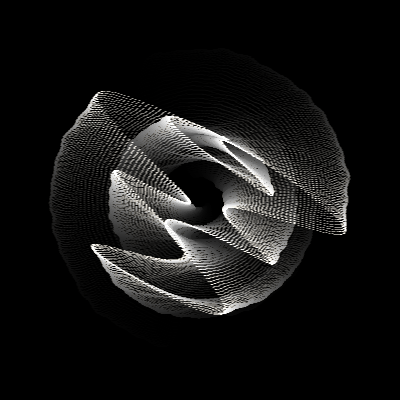
Daily Sketch Curve Morph (Synthetic Gesture)
audio_reactive · LiebermanDailySketch
A parametric polar / hypotrochoid curve whose three radii (R, r, d) are continuously morphed by independent sin-wave chains — Zach Lieberman's signature 'use mathematical functions like sin() and tan() in place of randomness' rule from his Daily Sketches project.
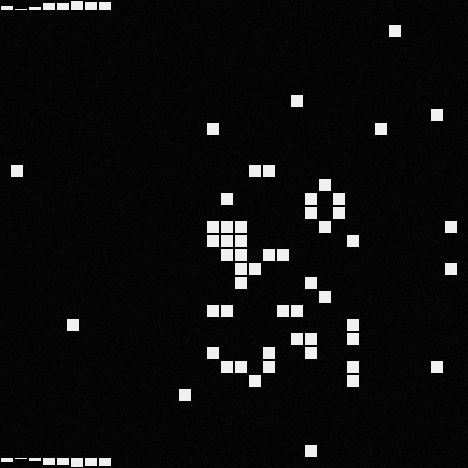
data.matrix Glitch Grid (Binary Cellular Automaton + Beat Faders)
audio_reactive · IkedaGridMatrix
A 32×32 binary cell grid plus a thin frame of beat-fader bars around the edges.
FFT-Spectrum Particle Field (Synthetic Audio)
audio_reactive · PasmaFFTSpectrum
A particle field whose velocity is driven by three FFT-magnitude bands (low / mid / high) computed from a sliding window of synthetic audio.
Reactive Concentric Rings (FFT-Band-Driven)
audio_reactive · PasmaReactiveCircle
N concentric rings around the canvas centre, each driven by a different FFT band (low / mid / high).