complexification_net · reactionDiffusion
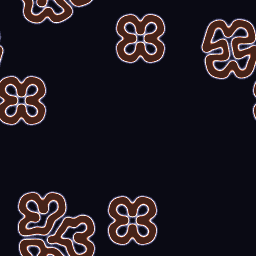
Reaction Diffusion (Gray-Scott)
Gray-Scott reaction-diffusion on a torus: two virtual chemicals U (substrate) and V (catalyst) react and diffuse on a 2D grid. V catalyzes U→V at rate U·V², U is replenished at rate feed·(1-U), and V decays at rate (feed+kill)·V. Diffusion is implemented with the 4-neighbor Laplacian stencil. The default F=0.055, k=0.062 parameter set lands in Pearson's 'mitosis' regime — circular V-bubbles grow, deform, and split into pairs that swim outward. Six presets are exposed: mitosis, spots, stripes, coral, maze, flicker — each corresponds to a different region of (F, k) parameter space.
Original: https://web.archive.org/web/20041229124929/http://www.levitated.net:80/daily/indexCategory.html
▶ Try the live demo (JS port) ▶ Run reference.py via Pyodide 10 formulas have instant JS ports. The Pyodide path runs the actual Python in your browser — first load is ~6 MB, then instant.
Math essence
Gray-Scott PDE on a periodic grid: U_{t+1} = U + dt·(Du·∇²U − UV² + F·(1−U)), V_{t+1} = V + dt·(Dv·∇²V + UV² − (F+k)·V). The 4-neighbor Laplacian is ∇²U = U_N + U_S + U_E + U_W − 4U. The bistable (F, k) parameter space yields Turing patterns: spots that propagate, stripes that wind, mazes that fill, and mitosis-like cell division.
Parameters
| Name | Type | Default | Range | Description |
|---|---|---|---|---|
dim | int | 256 | 100–600 | Square grid side length |
feed | float | 0.055 | 0.005–0.1 | Feed rate of U |
kill | float | 0.062 | 0.03–0.075 | Decay rate of V |
Du | float | 0.16 | 0.05–0.3 | Diffusion constant of U |
Dv | float | 0.08 | 0.02–0.2 | Diffusion constant of V |
dt | float | 1 | 0.5–1.5 | Euler time step |
seed_patches | int | 8 | 1–64 | Number of seed patches placed at reset |
seed_radius | int | 6 | 1–30 | Radius of each seed patch |
palette | str | ink | null–null | Palette name (ink / rust / coral) |
seed | int | null | 0–999999 | RNG seed |
Reference
First 60 lines of reference.py. Full source:
library_external/complexification_net/reactionDiffusion/reference.py
from __future__ import annotations

from typing import ClassVar

import imageio.v2 as imageio
import numpy as np


_PALETTES: dict[str, np.ndarray] = {
    "ink": np.array(
        [
            [10, 10, 20],
            [30, 30, 50],
            [60, 60, 90],
            [95, 95, 130],
            [130, 130, 170],
            [170, 165, 200],
            [210, 200, 220],
            [240, 230, 235],
            [255, 255, 255],
            [240, 220, 195],
            [220, 180, 150],
            [200, 140, 110],
            [180, 100, 75],
            [150, 70, 50],
            [110, 50, 35],
            [70, 35, 25],
        ],
        dtype=np.uint8,
    ),
    "rust": np.array(
        [
            [25, 12, 8],
            [60, 22, 8],
            [110, 38, 12],
            [165, 60, 18],
            [210, 90, 30],
            [240, 130, 50],
            [255, 175, 80],
            [255, 220, 130],
            [255, 248, 200],
            [220, 240, 220],
            [180, 220, 220],
            [140, 195, 210],
            [100, 160, 195],
            [60, 120, 170],
            [30, 80, 130],
            [10, 40, 80],
        ],
        dtype=np.uint8,
    ),
    "coral": np.array(
        [
            [10, 30, 50],
            [20, 60, 80],
            [40, 100, 110],
            [80, 140, 130],
            [130, 180, 140],
            [180, 210, 150],
            [230, 235, 165],
Try running it locally
The reference implementation is self-contained Python with numpy. Install the package and run:
python library_external/complexification_net/reactionDiffusion/reference.pyNeed help? See Learn for the standard environment setup, or Playground for an in-browser sketchbook.
More from complexification.net

Boundaries
complexification_net · boundaries
Boundaries traces gradient-magnitude contours on a fractal Brownian motion noise substrate.
Cellular Automata Worm
complexification_net · cellularAutomataWorm
The CA Worm is an expanding construction of a one-dimensional cellular automaton.
Cyclic Cellular Automaton
complexification_net · cyclicCellularAutomaton
A Greenberg-Hastings / Rock-Paper-Scissors style cyclic cellular automaton on a 2D torus.
Diffusion Limited Aggregation
complexification_net · diffusionLimitedAggregation
DLA is a simulated growth process: a sticky seed sits in a 2D field, wandering particles spawn along an outer circle, take unit-length random-walk steps, and stick to the cluster whenever they touch it.
Fibers (curling brush)
complexification_net · fibers
A field of curling fibers grown from random seeds scattered across the canvas.
Main Vein
complexification_net · mainVein
A single, meandering recursive vein grows from the center of a dark substrate.