reas_processing · voronoi
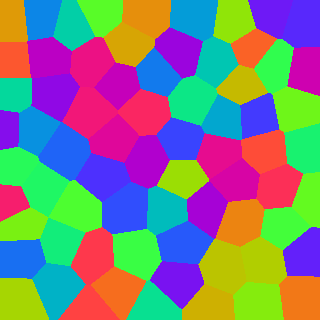
Voronoi Diagram from Random Seeds
Every pixel on the canvas is colored with the palette color of the seed point closest to it. Lloyd relaxation (centroid-snap iterations) runs at reset to even out cell sizes and produce the canonical Reas-style smooth mosaic. step(n) jitters each seed by Gaussian noise and re-relaxes, so the cells drift, grow, and merge slowly.
Original: https://en.wikipedia.org/wiki/Voronoi_diagram
▶ Try the live demo (JS port) ▶ Run reference.py via Pyodide 10 formulas have instant JS ports. The Pyodide path runs the actual Python in your browser — first load is ~6 MB, then instant.
Math essence
argmin_i || (x, y) - pts_i ||^2 over all pixels (x, y). Lloyd relaxation approximates: pts_i := mean(pixel : argmin = i) using a 32x32 subsample for speed.
Parameters
| Name | Type | Default | Range | Description |
|---|---|---|---|---|
dim | int | 320 | 80–1000 | Square canvas side length. |
num_seeds | int | 60 | 4–250 | Number of generator points. |
lloyd_steps | int | 6 | 0–30 | Lloyd relaxation rounds at reset and step. |
step_jitter | float | 6 | 0–50 | Gaussian sigma for per-step seed displacement (pixels). |
palette_mode | str | rainbow | — | rainbow, earth, grayscale, or cool color spread. |
seed | int | null | 0–999999 |
Reference
First 60 lines of reference.py. Full source:
library_external/reas_processing/voronoi/reference.py
from __future__ import annotations

from typing import ClassVar

import numpy as np


class Voronoi:
    """Voronoi diagram from jittered random seed points.

    A set of *num_seeds* points is sampled inside the canvas; each pixel
    is colored with the seed's color whose point it is closest to. On
    each ``step`` every seed drifts a small random amount, so the cell
    mosaic slowly shifts, grows, and merges. Lloyd relaxation (``n``
    rounds) snaps seeds toward their cell centroids before the first
    render, producing the smooth, even cells popular in Casey Reas's
    generative art canon.
    """

    family: ClassVar[str] = "reas_processing"
    sketch: ClassVar[str] = "voronoi"

    def __init__(
        self,
        dim: int = 320,
        num_seeds: int = 60,
        lloyd_steps: int = 6,
        step_jitter: float = 6.0,
        palette_mode: str = "rainbow",
        seed: int | None = None,
    ) -> None:
        self.dim = dim
        self.num_seeds = num_seeds
        self.lloyd_steps = lloyd_steps
        self.step_jitter = step_jitter
        self._palette_mode = palette_mode
        self._seed = seed
        self.reset()

    def reset(self, seed: int | None = None) -> None:
        if seed is not None:
            self._seed = seed
        self.rng = np.random.default_rng(self._seed)
        self.pts = self.rng.uniform(0, self.dim, size=(self.num_seeds, 2))
        self.colors = self._palette(self.num_seeds)
        for _ in range(self.lloyd_steps):
            self.pts = self._lloyd_step(self.pts)

    def _lloyd_step(self, pts: np.ndarray) -> np.ndarray:
        n = self.dim
        # coarse sub-sampling 32x32 instead of n*n for speed
        sub = 32
        grid = np.stack(
            np.meshgrid(
                np.linspace(0, n - 1, sub),
                np.linspace(0, n - 1, sub),
                indexing="ij",
            ),
            axis=-1,
        ).reshape(-1, 2)
Try running it locally
The reference implementation is self-contained Python with numpy. Install the package and run:
python library_external/reas_processing/voronoi/reference.pyNeed help? See Learn for the standard environment setup, or Playground for an in-browser sketchbook.
More from reas · processing
2-D Totalistic Cellular Automaton (Conway + variants)
reas_processing · wolframCA2D
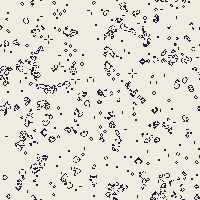
Each cell looks at its 8 Moore neighbors and applies a totalistic rule.
Gray-Scott Reaction-Diffusion
reas_processing · grayScottRD
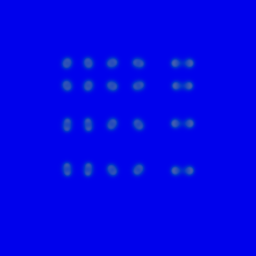
Two scalar species U and V diffuse on a square grid with rates Du and Dv and react with feed F and kill k.
Lindenmayer L-system + Turtle Rendering
reas_processing · lindenmayer
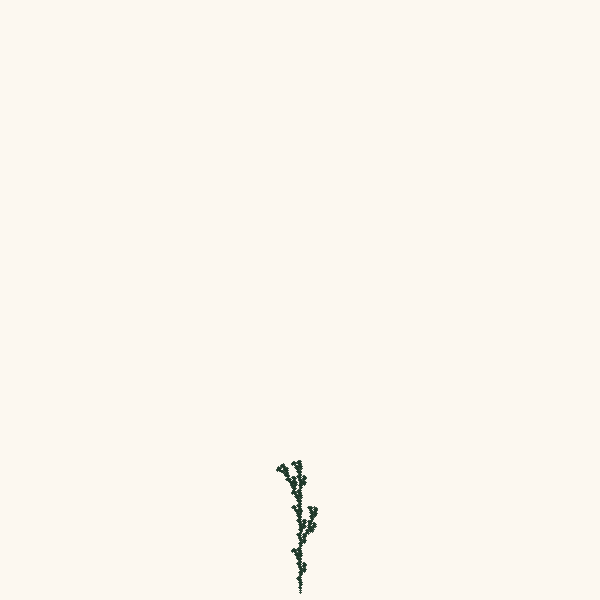
An axiom string is rewritten by parallel production rules for a fixed number of iterations, then interpreted by a 2-D turtle: 'F' walks forward, '+/-' turn left/right, '['/']' push/pop state.
Particle-Spring Cloth (Verlet + Hooke)
reas_processing · particleSpring
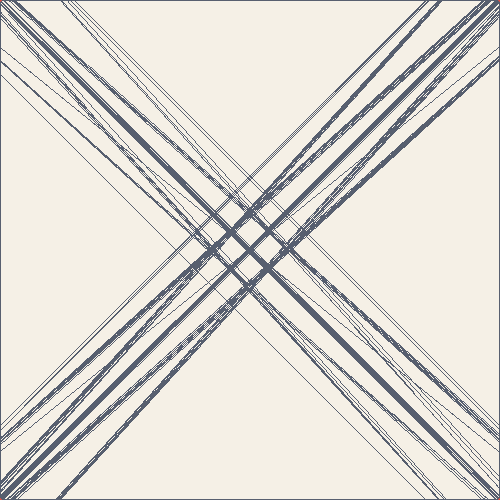
A rectangular grid of free particles is connected by Hooke's-law springs at rest length 'spacing'.
Perlin Streamlines
reas_processing · perlinStreamlines
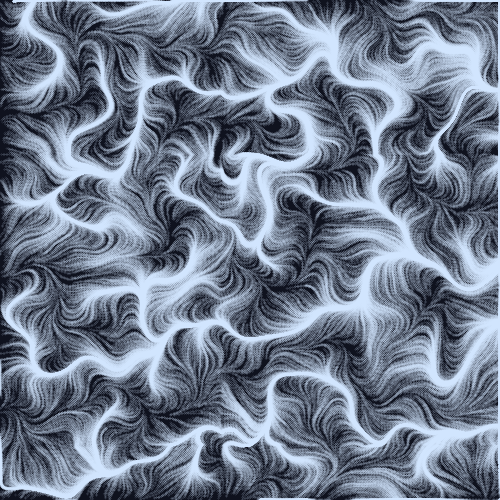
A 2-D vector field is sampled from one or more octaves of Perlin gradient noise.
Wolfram Elementary 1-D Cellular Automaton
reas_processing · wolframCA1D
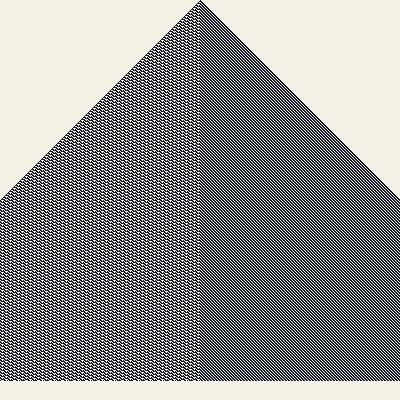
Each row of the canvas is one generation of a Wolfram elementary cellular automaton.