
shader_legends_3 · BigWingsClouds
Volumetric Clouds from Cellular + FBM
A painterly cumulus-cloud sky built from a Worley/cellular noise layer (cloud puffs) gated by a low-frequency FBM (large-scale cloud coverage) and a high-frequency FBM (in-cloud detail). The combined field is smoothstepped into a coverage mask, then composited over a sky-blue gradient and lit vertically (darker at the base, brighter at the top) with a warm sun-glow tint near the upper-right. The result is a recognisable 'clouds seen from above' scene built from three different noise primitives.
Original: https://www.shadertoy.com/results?query=bigwings+clouds
▶ Try the live demo (JS port) ▶ Run reference.py via Pyodide 10 formulas have instant JS ports. The Pyodide path runs the actual Python in your browser — first load is ~6 MB, then instant.
Math essence
f = (1 - cellular_2d(uv)) * (0.6 + 0.5 * fbm(uv, 4 octaves)) + 0.5 * fbm(uv * scale_detail, 3 octaves) * (1 - cellular_2d(uv)). coverage = smoothstep(coverage_low, coverage_high, f). col = lerp(sky, cloud_base + (cloud_top - cloud_base) * lighting(y), coverage) + sun_color * exp(-sun_dist * 2) * 0.20.
Parameters
| Name | Type | Default | Range | Description |
|---|---|---|---|---|
dim | int | 400 | 160–800 | Square output size in pixels. |
cloud_scale | float | 3.5 | 1–12 | Worley/cellular sample rate. |
detail_scale | float | 11 | 4–30 | High-frequency detail FBM rate. |
large_octaves | int | 4 | 2–7 | FBM octaves for the large-scale coverage layer. |
detail_octaves | int | 3 | 1–5 | FBM octaves for the in-cloud detail layer. |
coverage_low | float | 0.42 | 0.2–0.65 | Lower bound of the smoothstep coverage mask. |
coverage_high | float | 0.92 | 0.65–0.99 | Upper bound of the smoothstep coverage mask. |
sky_color | rgb | 0.45,0.65,0.85 | null–null | Sky base colour. |
cloud_base | rgb | 0.65,0.65,0.7 | null–null | Cloud colour at the base. |
cloud_top | rgb | 1,1,1 | null–null | Cloud colour at the top. |
sun_color | rgb | 1,0.9,0.65 | null–null | Sun-glow tint. |
sun_x | float | 0.72 | 0–1 | Sun x position in canvas units. |
sun_y | float | 0.3 | 0–1 | Sun y position in canvas units. |
drift | float | 0.03 | -0.3–0.3 | Per-step drift of all noise samples (cloud motion). |
Reference
First 60 lines of reference.py. Full source:
library_external/shader_legends_3/BigWingsClouds/reference.py
from __future__ import annotations

from typing import ClassVar

import numpy as np


def _hash22(x: np.ndarray, y: np.ndarray, seed: int) -> tuple[np.ndarray, np.ndarray]:
    """Two-component hash from integer (x, y) → ([0, 1), [0, 1))."""
    x = np.asarray(x, dtype=np.int64)
    y = np.asarray(y, dtype=np.int64)
    p = (x * np.int64(374761393) + y * np.int64(668265263) + np.int64(seed)) & np.int64(0xFFFFFFFF)
    p = (p ^ (p >> np.int64(13))) * np.int64(1274126177) & np.int64(0xFFFFFFFF)
    p = p ^ (p >> np.int64(16))
    a = (p & np.int64(0xFFFFFFFF)).astype(np.float32) / np.float32(0xFFFFFFFF)
    p2 = (p * np.int64(2147483647) + np.int64(1013904223)) & np.int64(0xFFFFFFFF)
    p2 = (p2 ^ (p2 >> np.int64(16))) & np.int64(0xFFFFFFFF)
    b = p2.astype(np.float32) / np.float32(0xFFFFFFFF)
    return a, b


def _hash21(x: np.ndarray, y: np.ndarray, seed: int) -> np.ndarray:
    x = np.asarray(x, dtype=np.int64)
    y = np.asarray(y, dtype=np.int64)
    p = (x * np.int64(374761393) + y * np.int64(668265263) + np.int64(seed)) & np.int64(0xFFFFFFFF)
    p = (p ^ (p >> np.int64(13))) * np.int64(1274126177) & np.int64(0xFFFFFFFF)
    p = p ^ (p >> np.int64(16))
    return (p & np.int64(0xFFFFFFFF)).astype(np.float32) / np.float32(0xFFFFFFFF)


def _value_noise_2d(x: np.ndarray, y: np.ndarray, seed: int) -> np.ndarray:
    """Bilinearly smoothed value noise from a deterministic hash."""
    xi = np.floor(x).astype(np.int64)
    yi = np.floor(y).astype(np.int64)
    xf = (x - xi).astype(np.float32)
    yf = (y - yi).astype(np.float32)
    u = xf * xf * (3.0 - 2.0 * xf)
    v = yf * yf * (3.0 - 2.0 * yf)
    n00 = _hash21(xi, yi + seed, 0)
    n10 = _hash21(xi + 1, yi + seed, 0)
    n01 = _hash21(xi, yi + 1 + seed, 0)
    n11 = _hash21(xi + 1, yi + 1 + seed, 0)
    nx0 = n00 * (1.0 - u) + n10 * u
    nx1 = n01 * (1.0 - u) + n11 * u
    return nx0 * (1.0 - v) + nx1 * v


def _fbm(x: np.ndarray, y: np.ndarray, octaves: int, seed: int, lac: float = 2.0, gain: float = 0.5) -> np.ndarray:
    total = np.zeros_like(x, dtype=np.float32)
    amp = np.float32(1.0)
    freq = np.float32(1.0)
    norm = np.float32(0.0)
    for k in range(octaves):
        total = total + amp * _value_noise_2d(x * freq, y * freq, seed + k * 17)
        norm = norm + amp
        amp = amp * np.float32(gain)
        freq = freq * np.float32(lac)
    return total / max(norm, 1e-6)
Try running it locally
The reference implementation is self-contained Python with numpy. Install the package and run:
python library_external/shader_legends_3/BigWingsClouds/reference.pyNeed help? See Learn for the standard environment setup, or Playground for an in-browser sketchbook.
More from shader_legends_3
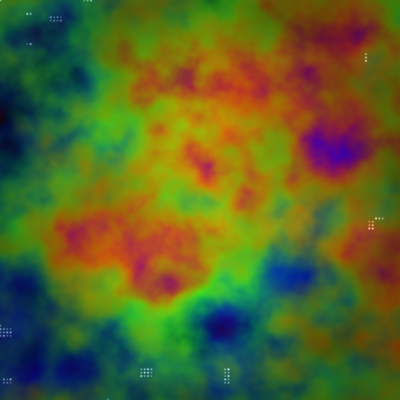
Animated FBM Nebula with Chromatic Aberration
shader_legends_3 · AshleyGAnimNebula
A multi-coloured, slowly rotating cosmic gas cloud built from 5 layers of FBM noise at different scales, each layer rotated by a different angle that varies with time.
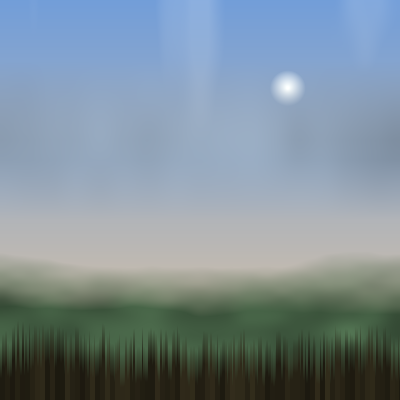
Atmospheric Perspective Landscape
shader_legends_3 · HubertyAtmospheric
A painterly 2D landscape built from depth-graded FBM bands: a soft sky gradient with a sun disc and cloud streaks, a low-amp haze band in the upper-middle, rolling green midground hills, and a sharp foreground silhouette of trees and grass.
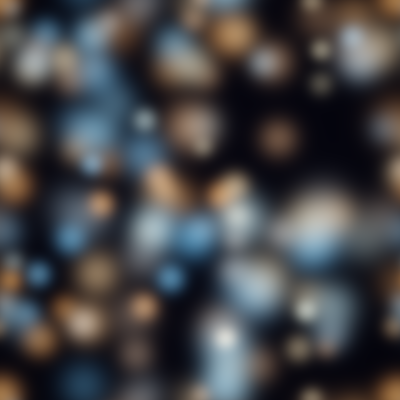
Bokeh Blur with Light Leaks
shader_legends_3 · TaterBokeh
A 2D bokeh effect built by stamping 50-200 soft Gaussian discs onto a near-black backdrop, each at a hash-determined centre, radius, and warm-to-cool colour.
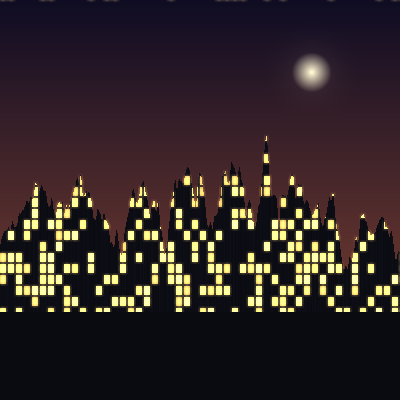
Hash-driven Procedural City Skyline
shader_legends_3 · DaveHoskinsHashCity
A 2D orthographic night-time cityscape whose per-column building heights come from 1D FBM noise and whose lit windows are a per-cell hash threshold.
Recursive Spherical Displacement Wireframe
shader_legends_3 · IQDisplacementSphere
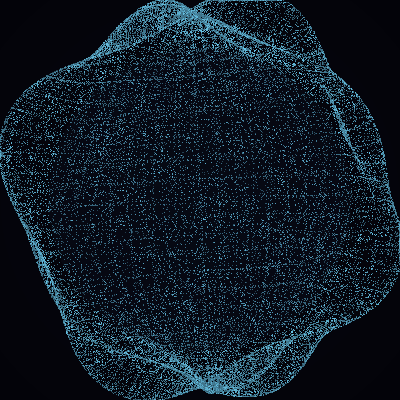
A wireframe sphere whose surface is recursively displaced by spherical harmonics of the form amp * sin(N * theta) * cos(M * phi), rendered as overlapping latitude and meridian polylines plus random surface dots.