Source group · 5 artworks · 1 families
generative pioneers
The pioneers — Vera Molnar, Manfred Mohr, Frieder Nake, and the earliest computer art.
Path on disk: library_external/generative_pioneers/
No artworks match those filters. Try clearing one of the dropdowns.
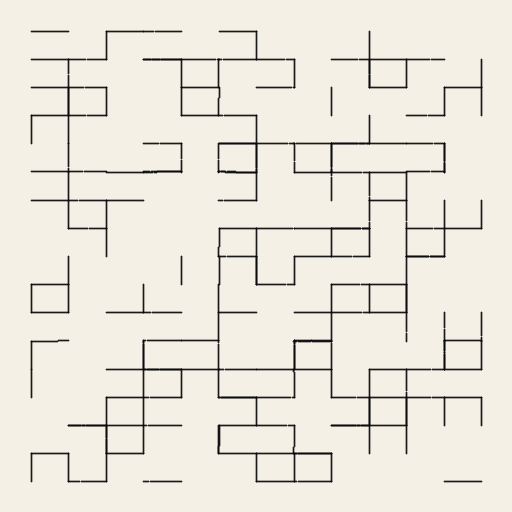
Interruptions (Molnár)
generative_pioneers · molnar_interruptions
Vera Molnár's 1968 'Interruptions' series: a regular grid of rectangle cells where each cell's four border edges are drawn independently, each with its own random probability of being omitted.
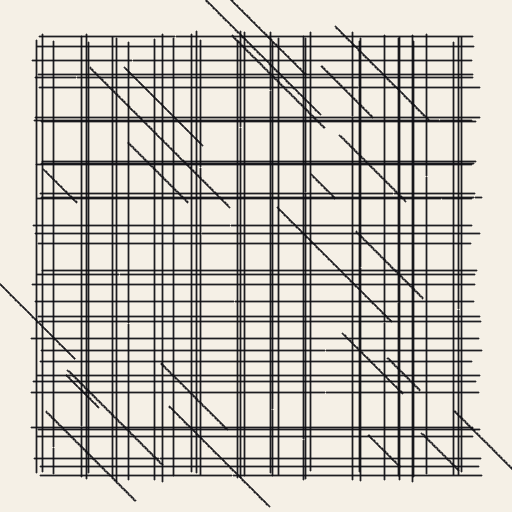
Line Arrangements (Mohr)
generative_pioneers · mohr_line_arrangement
Manfred Mohr's 1969 plotter 'Line Arrangements': a fixed grid of columns and rows, each carrying a small set of nearly-parallel lines whose exact positions are random within the cell, overlaid with a layer of 45° diagonals whose length, position and orientation are independently random.
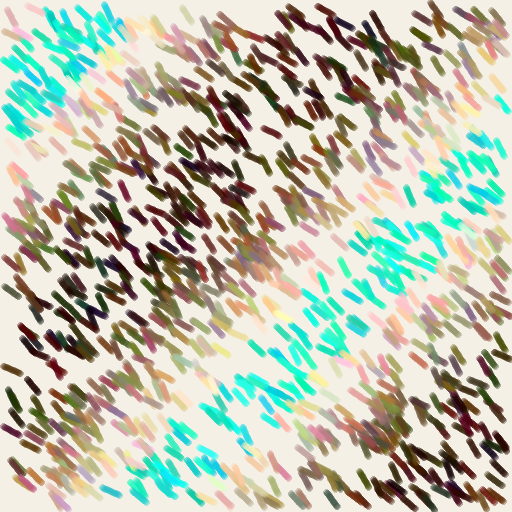
Paint by Numbers (Haeberli)
generative_pioneers · haeberli_painterly
Paul Haeberli's 1990 SIGGRAPH 'Paint by Numbers' — the founding paper of stroke-based rendering.
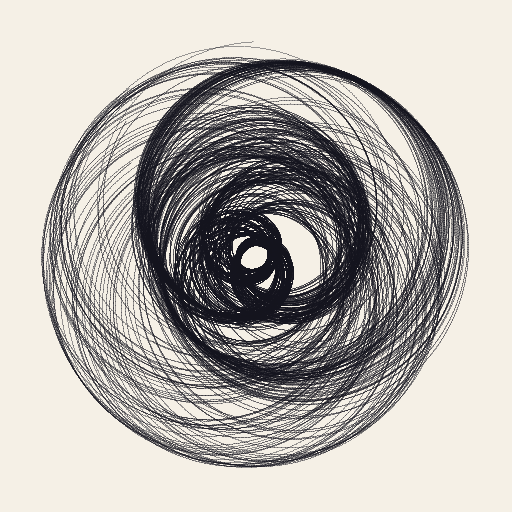
Plotter Trajectories (Hébert)
generative_pioneers · hebert_plotter_trajectory
Jean-Pierre Hébert's plotter-trajectory idiom — parametric Lissajous-like curves drawn over multiple passes, each pass slightly phase-shifted, each segment modulated by the local velocity of the pen so that slow regions lay down heavier pigment and fast regions trace a ghost line.
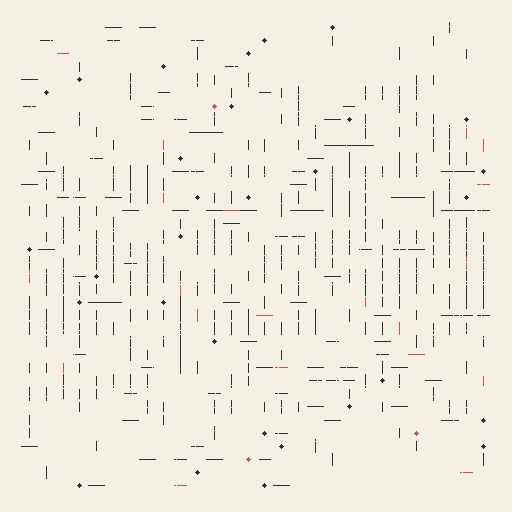
Walk-through-Raster (Nake)
generative_pioneers · nake_walk_sequence
Frieder Nake's 1966 'Walk-through-Raster' program (Algol 60 on a Telefunken TR4, plotted on a ZUSE Graphomat Z64): a repertoire of six signs — empty, vshort, vlong, hshort, hlong, dot — is sampled into a Markov chain whose transition probabilities vary with chain position so that 'vertical strokes are high at the chain's middle, empties dominate at the ends'.