Source group · 7 artworks · 1 families
generative_pioneers_2
Source group: generative_pioneers_2.
Path on disk: library_external/generative_pioneers_2/
No artworks match those filters. Try clearing one of the dropdowns.

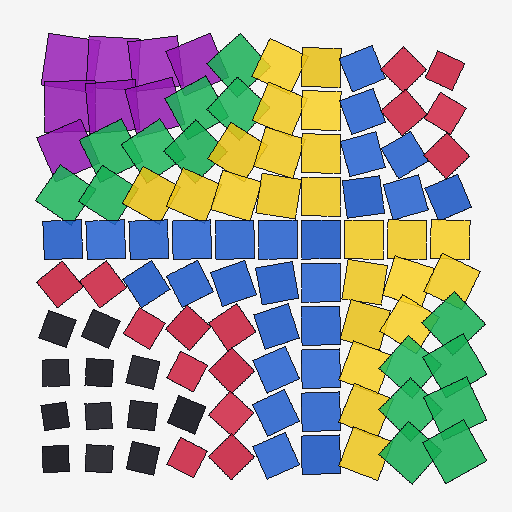
Computer-Aided Painting (Schwartz)
generative_pioneers_2 · lillian_schwartz
Lillian Schwartz, who worked at Bell Labs from 1968 to 2001 with Kenneth C.
Hypertransformations (Molnár)
generative_pioneers_2 · molnar_hypertransformations
Vera Molnár's 'Hypertransformations' (1974-1976), executed on the IBM 360 with a CRT 2250 display and output on a Benson plotter.
P-159 D (Mohr)
generative_pioneers_2 · mohr_p159d
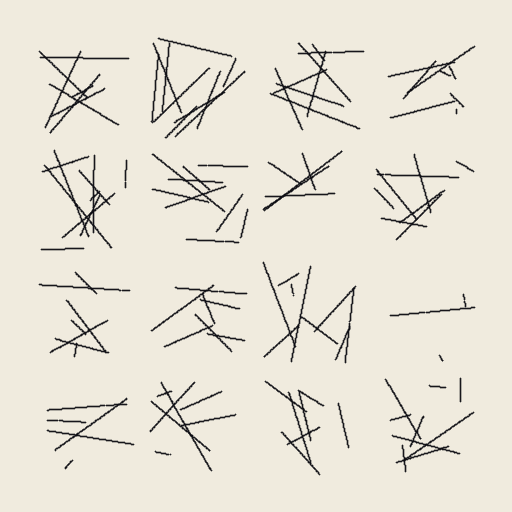
Manfred Mohr's 'P-159 D' (1969, Vincennes) sits in the P-159 family that the artist developed from his earlier P-021 / P-036 line-arrangement programs.
Raster Sequence (Nake)
generative_pioneers_2 · nake_raster_sequence
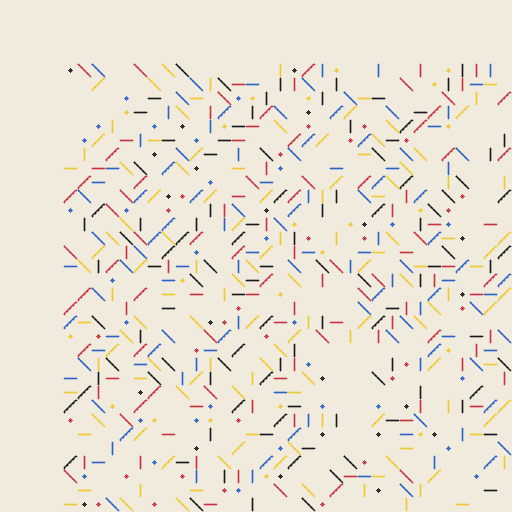
Frieder Nake's 'Walk-through-Raster' / 'Raster Sequence' (1966) is the first non-stationary Markov chain in computer art history.
Structure Computer (Cohen / AARON)
generative_pioneers_2 · cohen_structure_computer
Harold Cohen's AARON, begun at UCSD in 1967-1973 and continuously developed until Cohen's death in 2016, is the longest-running art-making AI in history.
Text Rain (Utterback & Achituv)
generative_pioneers_2 · utterback_text_rain
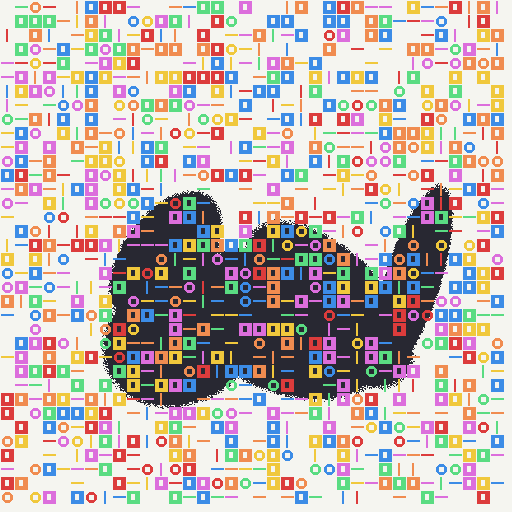
Camille Utterback and Romy Achituv's 'Text Rain' (1999) is one of the canonical interactive installations of the late-1990s computer-vision era, and the piece that won them a US patent (US 6,928,313) in 2005.
Wall Drawings (LeWitt)
generative_pioneers_2 · sol_lewitt_wall_drawings
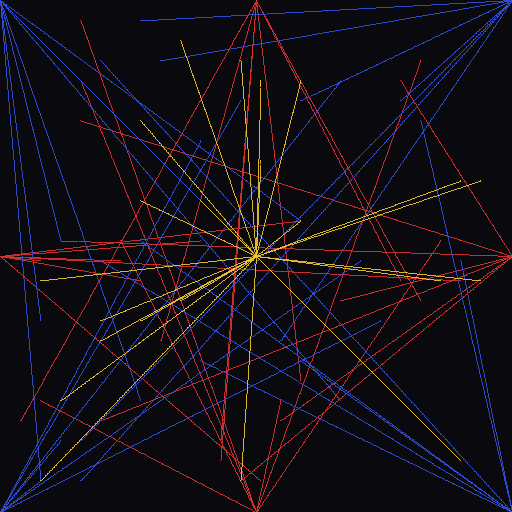
Sol LeWitt's wall drawings (1968-2007) are the canonical example of conceptual-art-as-algorithm: the work is the set of written instructions, and any number of draftspeople can execute them with different results that all satisfy the same rule.